Prayers at Maple Tree Medows

Prayers at Maple Tree Medows
Three Rivers, MI

Monday, September 5, 2011

IN LIGHT OF HENRY’S BARNS…

In early summer I heard one family's story of the development of seed corn farming in Constantine, Michigan,"The Seed Corn Capital of the World." I toured a series of barns that have been part of the life of farmer, Henry Miller. Listening to this series of barn stories helped me to connect the dots to stories I had just heard as generalizations -- homesteaders, family farmers, farms in foreclosure and growing seed corn farms.

Look what I saw when Henry opened the windows and doors of
the barns of the last fifty years of his farming life.

I AM THE BARN WHERE HENRY FIRST WORKED

I am an old homestead barn. Pashby land, I was. First barn on this land. Henry’s father bought me back in the 60’s and had to shore me up again. Took down forty oaks right round me, he did. Strong beams from this oak savanna land.

Making space for 400 laying hens, then milk cows, then hogs. Why, twelve year old Henry, back then, he learned to fed the hogs that were farrowing, and sometimes forgot, letting the water trough flood. Then he would muck that barn floor all over again.

Climbing my rafter beams, that boy did! Thought he could do anything. When the new cement floor was poured, he drove the tractor: age thirteen.

Henry's father, when he was in his fifties, farmed chickens, hogs, beef and dairy cattle, corn, wheat, oats, hay, soybeans with one tractor then on 160 acres of land. He has passed on now. And here I stand, tight and dry, but a foreclosed barn, now in 2011.


I AM THE BARN THAT HENRY WATCHED BUILT

Sheds and barns went up and down on this land. Old grain cribs came down with age, and the shed for tools and wood had its roof blows off in a tornado just second after Henry ran for the house right round its edge. Roof landed by the cows – across the fence in the next pasture. Did they jump or get carried in that tornado wind? I like to think the tornado did it.

Me? I just stood here, dumb and plain. I was the chicken house Henry’s father contracted to stand. A pole building, simple like the former Amishman. But there was more in my plan.


I AM THE BARN THAT HENRY FIRST BUILT AT AGE FIFTEEN

So, when Henry’s father (when Henry was fifteen) thought his equipment needed more place to stand, he planned on hired builders again.

Henry took a good look at the chicken house pole barn and said, “Well, we can just look at that one and make one ourselves.” He convinced him that he could do it and, sure enough, they built the trusses together in the big barn.

Yep. Henry built me to stand. I remain on his farm land housing equipment to this day.


WE ARE THE VILLA MILLER BARNS HENRY BUILT

There was an old barn on this farm of 270 acres when Henry Miller and his wife, Martha Villalobos bought it in 1977. This has become Villa-Miller Farms.

Back then there was a barn to the southeast, and next to it, a granary, an old corn crib, another corn crib and shed. The barn and old buildings came down for the new era. There had been decades when the land had been idle in the government “soil bank” program – conserving land and preventing over-production of corn. But the new era of seed corn had begun.

It wasn’t so hard to get us barns up back then. You could get the land for $750/acre back then. And loans were going at 8%. With electric powered irrigation, ample water and sandy soil, lots of seed corn companies contracted this area back then: Pioneer, Super Cross, Decalb, Cargill, Select Seeds, Remington, Great Lakes, and more. After the national corn blight of the sixties, the price of corn which had fallen into shortage promised good wages to farm.

Henry could build grain storage for soybean and wheat – at yields of 40-50 bushels (soybeans) or 70 bushels (wheat) per acre. But at yields of 200 bushels an acre for corn, and the going price of $8 per bushel at the beginning of 1977, it looked like seed corn farming would boom.

Little did Henry know that the price of seed corn would soon drop to about $5 per bushel. And by harvest in 1977 the price of his male corn, the profit he could keep, would be $1.35 per bushel due to boom new varieties of hybrid corn. And banks in the area bumped interest up to twelve and fourteen, even eighteen percent. For farmers who had their loans called in, the Constantine Seed Corn Capital was a nightmare.

But Henry’s barns, we stand. First set of six machines that ran this land needed pole barn room to stand. Now they have grown bigger, more techy, in the last thirty five years. Tractor, plough, planter, sprayer and the harvester Henry shared with his dad in 1977 could till 12 feet row strips of land. Now they have become a strip tiller, planter, and sprayer with a tractor to pull each one as they cover 40 foot row strips

And need more barns and shops, fertilizer storage to stand.Pioneer comes in with the equipment for the harvest and stores the corn. If not, Henry would still be building!

This summer, the wheat’s already in. Corn harvest should be done by mid October, Henry says. Peas have been sown where the wheat stubble stands, to enrich the soil and allow the stubble to break down. Henry drives over his fields fewer and fewer times as the years progress. Conserving fuel and preserving topsoil are major investments for him. And protecting the future of farming on this land.

A different kind of barn work than when he first began. Loved climbing those beams. Beams still shelter him.

Thursday, August 25, 2011

STORY BARN ABROAD -- Thiessen Farm, Ontario

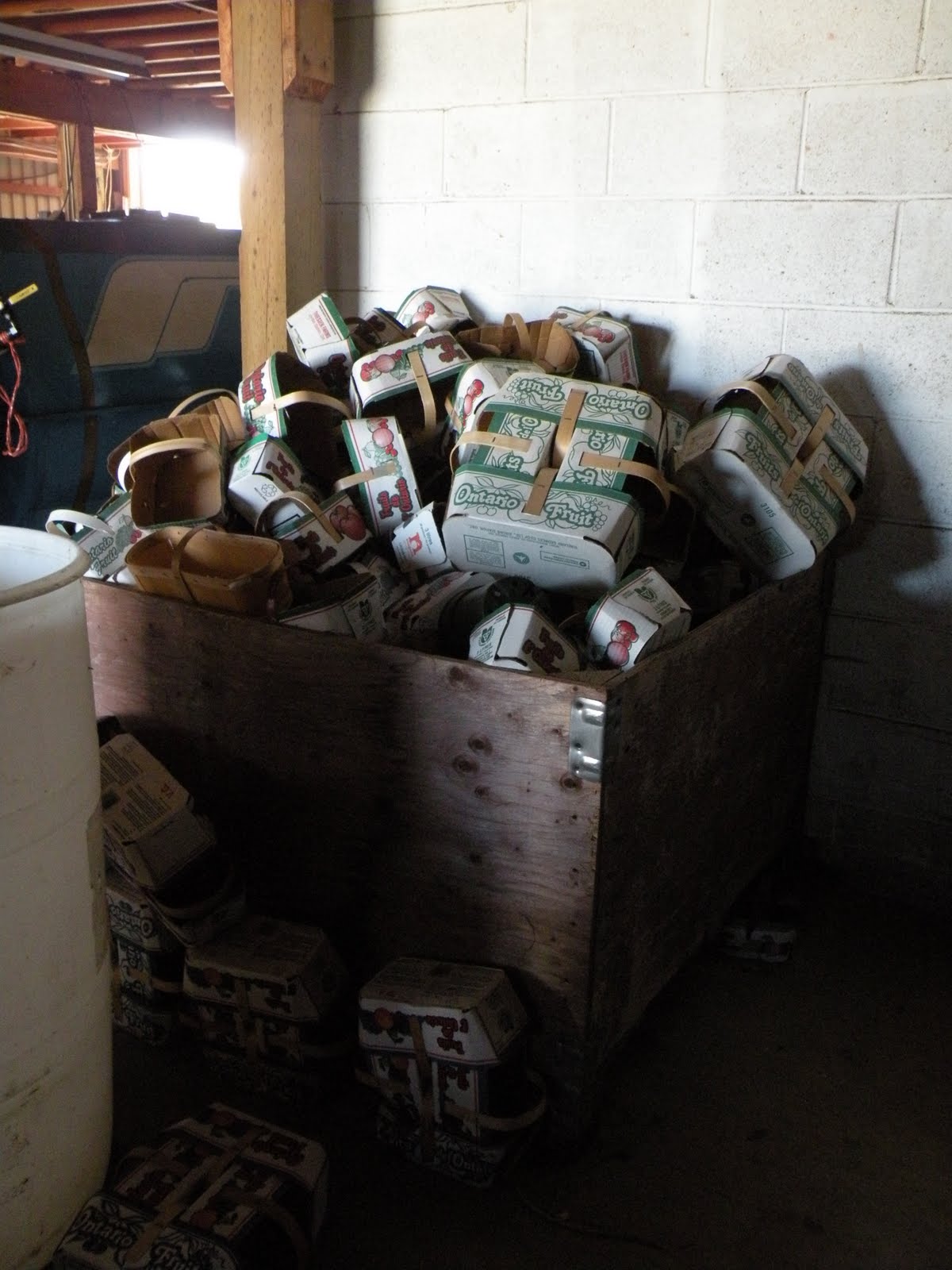
I made a quick trip in April to the Niagara Peninsula where I visited my friends Ron and Lori Thiessen. I was last at the farm four years ago, and much had changed. In addition to growing fruit and some vegetable for market, they are in their second year of CSA (Community Supported Agriculture) farming. They nearly doubled the number of CSA from the first year to this one. I remember helping to sort and pack peaches in this barn.

SPRING AT THIESSEN FARM -- Jordan Station, Ontario

To see and read what Thiessen Farm looks like now, in the height of harvest, visit their excellent blog -- thiessenfarms.blogspot.com


I am a barn.

And I am a barn within a barn.

I was a post war barn first. A simple barn. A hard won barn.

My nails were rationed. Each day Pete and Jim, neighbors, friends, went to the hardware to get a handful of nails. Each day they got just enough to keep the building of us two side by side barns going. Russian Mennonite farmers, practical, they put two identical barns up. An act of faith. Planting fruit trees with nothing to sell. Tending them. Pruning. Watching through winter and frost, early and late. Hoping on blossoms. Spraying. Rain. Shine. Waiting for cherries, peaches, plums, pears to come.

Back in ’46 we seemed ambitious barns, side by side. And fruit farms cropped up below the Niagara escarpment.

I got fancy in the 70’s and added a walk in cooler. That keeps the soft fruits happy.

Then I got surrounded by a whole new exterior. Basically they built room for packing fruit all around me! Guts still the same. Now more space for packing boxes and conveyer belts to keep those peaches coming.

Like any barn – cats, inventions, old machines, storage, vestiges of history. Here in the spring, I am pretty quiet. Boxes waiting. Containers for plants empty.

But with all those blossoms out there, it won’t seem long – as history goes for me – till the Mexican workers are back and the young farm hands are flying around the trees on jitnees and customers are pulling in the drive to pick up their shares of all that good food.

Yes, I hold generations of stories, in layers, just like this peninsula. There used to be six fruit canning plants on the Niagara Peninsula. Delmonte was one who got our peaches. The last of the canneries moved away last year. And the new owners of Jim’s old farm pulled out all the peach trees. They were canning variety. Wouldn’t sell. So my neighbor barn, my twin, looks just the same on the inside with some new young whipper snapper farmers on the inside, dreaming of feeding people vegetables and all manner of things from this same land.

We’ll see, we’ll see, when summer comes. When the peaches and pears and plums are heavy again – and now tomatoes will try to outshine them….

BACK TO THE BARNS

I started in the dark -- looking and listening to barns. Last November I visited Maple Tree Meadows at night.


Look! Summer has come and almost gone, and I am finally back to barns.


UPDATES: I made two barn visits in the spring which I will be posting soon. I will soon revisit some of the "working barns" to see what they are holding now in harvest season.

My plan was to do STORY BARN for a year, so it is time to get going again.

And you can help:


YOUR BARNS TO VISIT: If you have a barn you would like me to visit in Elkhart County, IN or St. Joseph or Cass County, MI, let me know.

YOUR BARN STORIES: If you have childhood memory of a barn, send it to me and I will try to post it, with or without a photo.

STORY BARN CELEBRATION: I am planning for a potluck, barn story swapping and barn dance for late in the fall. Details to come!

Contact me at ninalblanctot@msn.com -- Nina!

Tuesday, April 5, 2011

APPLE FARM BARN: Woman Built Womb

I have known of Apple Farm for many years, and visited three times. My barn visit was the longest, and most soulful. You can read about Apple Farm Community at their website. Here is their own introduction. I will let it, and the barn, speak for themselves.


Apple Farm in Michigan is not a "Community" in the ordinary sense of the word. It was not founded as a planned institution but came into being as a focal point for a number of women who had been drawn together already by a community of interests and values.

Helen Luke who was trained in the work of Carl Gustav Jung, came to live in Three Rivers in 1962. Within a year, four persons who knew her came to live in the area, seeking answers to the search for meaning in life. Others came to live and work nearby and persons began to come from a distance. It was clear that a center was needed for the group, and through the generosity of friends, a house was bought with some land and a barn. An old school house was converted into a guest house. Over the years other buildings were added as needs arose. Apple Farm is a non-profit charitable corporation supported by contributions from guests and friends.


Here is the story of my life as a barn as I have been told it:

Helen Luke, Jane Bishop and Elsa, shepherding horses, cows, sheep and cats, walked down Hoffman Road in 1966 to the land and pasture and woods around me known as Apple Farm. They came home to this abandoned farm whose old orchard was past productive bearing. They, too, in their late years, made a new beginning, community, deliberately, together, and deep.

Dreamers have gathered round me, those, with the women, who listened to the wisdom of the innerlands and then rooted their lives in daily feeding, watering, milking, riding, teas and meals, artwork and recitations, and on and on in the seasonal lambing, Christmas and Easter, birth, deaths and slaughter.

Rooted in Jung -- images, stories, and sensations deep from the dreaming soul -- they dug longing roots.

Before them the old school house that stands before me had been moved down the same road to serve as the barn for the animal, land, people and dream community. But it was such a good space that humans dwelled there.

Yet a barn was necessary. So Jane and Elsa built me. Jane, having grown on a farm, knew the way. Elsa, it is said, dropped a two by six on her head, but she was only stunned. Here is the evidence of their work, their love. I stand.

A woman made barn, I have a soul different. I am the protection of all barns, but surface dreams into consciousness, a meeting place between the instincts of earth, the souls of animals and the psyches of seekers.


Moon, the blind mare, lived here with her obstinate son, Sunny. He mistreated her, so there, under the old apple tree, she had a safe place of her own.


Pigs lived here. Sheep and lambs. A cow. Horses. Always chickens.

All seasons have met within me.

Birth: The Christmas eve, after the fancy tea, a calf was midwived by impeccably dressed guests, into life.

Growth: La Leche style intervention was applied by Joan to the ewe who birthed three lambs. To get the third to suckle, the ewe was turned, and held on her back, teets to the air, while the tiny straggler latched on. The little lamb (“who made thee?”) survived, thrived, with the aid of motherly insistence.

Romance: Entering heat for the first time, another calf found Don. While he was working on foundation, 1968, painting tar on stable walls, this hefty heifer cornered him, moaning, wooing, yes, even climbing his back, and placing her hooves on his shoulders, until he broke a broomstick over her head and led her, lowing, into the security of a stall.

Death: Keeping vigil for a dying cat drew the community from group meeting to the barn to be, to wait for her passing.

The Barn.

I may not appear so to the uninitiated eye. But forty five years later I stand with all my adaptations showing boldly.


Life is arranged as needed here. “Just so,” it can be. Useful. Accommodating. Even so, as Helen died, and then Jane, and the backs of those living around me became weary, worn and sad, the animals went.


No more Guernsey cow to milk, nor thick cream for tea. No more sheep and lambs on the hillside to draw the eye of the troubled guest into stillness. The horses were last. Moon and Sunny. Hard to let them go.

The addition that was the art room holds only storage. A drawing table, cobwebbed.


The area above the stable has become home to George, who tends the property for the community living here and guests.


There is a shop for necessary things.


There is storage, and that which is waiting to be let go. When the time is right.


My barn door is the liminal space between shelter and the open.


It is consecrated by Saint Francis whose blessing is evident, even all these years later. He who knew Jesus amidst animals from birth cherishes both the memory and mess of me.


Animal souls live on. Humans come and go.


Three hens remain. Fitting, don’t you think? Three bold hens. Laying. Murmuring to each other. Praying.


The people in this community hear their prayer and join the longing for the animals to return. They will, when the time comes.

Here we (yes, I am included) read the psalms and Shakespeare, poems and dreams. My favorite poem is here, with fondness for Helen and Jane and Eleanore, the hens, the women, who have given me heart. You are welcome here.

Let Go. Return
by Josephine W. Johnson
(1910 American novelist, poet)

This is the need, the deep necessity of every life:
To scatter wide seed in many fields,
But build one barn.

This is our blunder, to have built
Gilt shacks for every seed,
And followed our sowing on fast anxious feet,
Desiring to grind the farmost grain.

Let go. Let go. Return
Heighten and straighten the barn's first beam.
Give shape and form. Discover the rat,
the splintered stair.
Throw out the dry, gray corn.

Then may it be said of you:
Behold, he had done one thing well,
And he knows whereof he speaks, and he means what he has said,
And we may trust him.
This is sufficient for a life.


Helen Luke and Apple Farm Community --

Then may it be said of you:
Behold, she had done one thing well,
And she knows whereof she speaks, and she means what she has said,
And we may trust her.

This is sufficient for a life.