Prayers at Maple Tree Medows

Prayers at Maple Tree Medows
Three Rivers, MI

Monday, December 20, 2010

NOFSINGER HOME, WOODSHAPER SHOP: TWO BARNS RE-BORN


I overheard Gary Nofsinger say that the siding of his shop for the Woodshaper contracting business came from the family barn in Illinois. This siding ties Gary to over 130 years of barn history and his childhood memories of storing hay and shooting hoops in that same barn.


I overlooked the obvious: his home. The post and beam structure was also a recycled barn from nearby Jones, MI. Unlike the Lind home and St. Joseph’s Barn at The Hermitage, Gary did not design the home to obviously replicate barn style structure. He used the beams for their strength to support the home, leaving the hewn textures to show their character. Gary and Chris designed this home for the kind of open space and light in which they wanted to live. And Gary was able to use many other recycled elements from materials available from his carpentry work.

The stories of both barns intertwined on a snowy Sunday afternoon the week before Christmas.
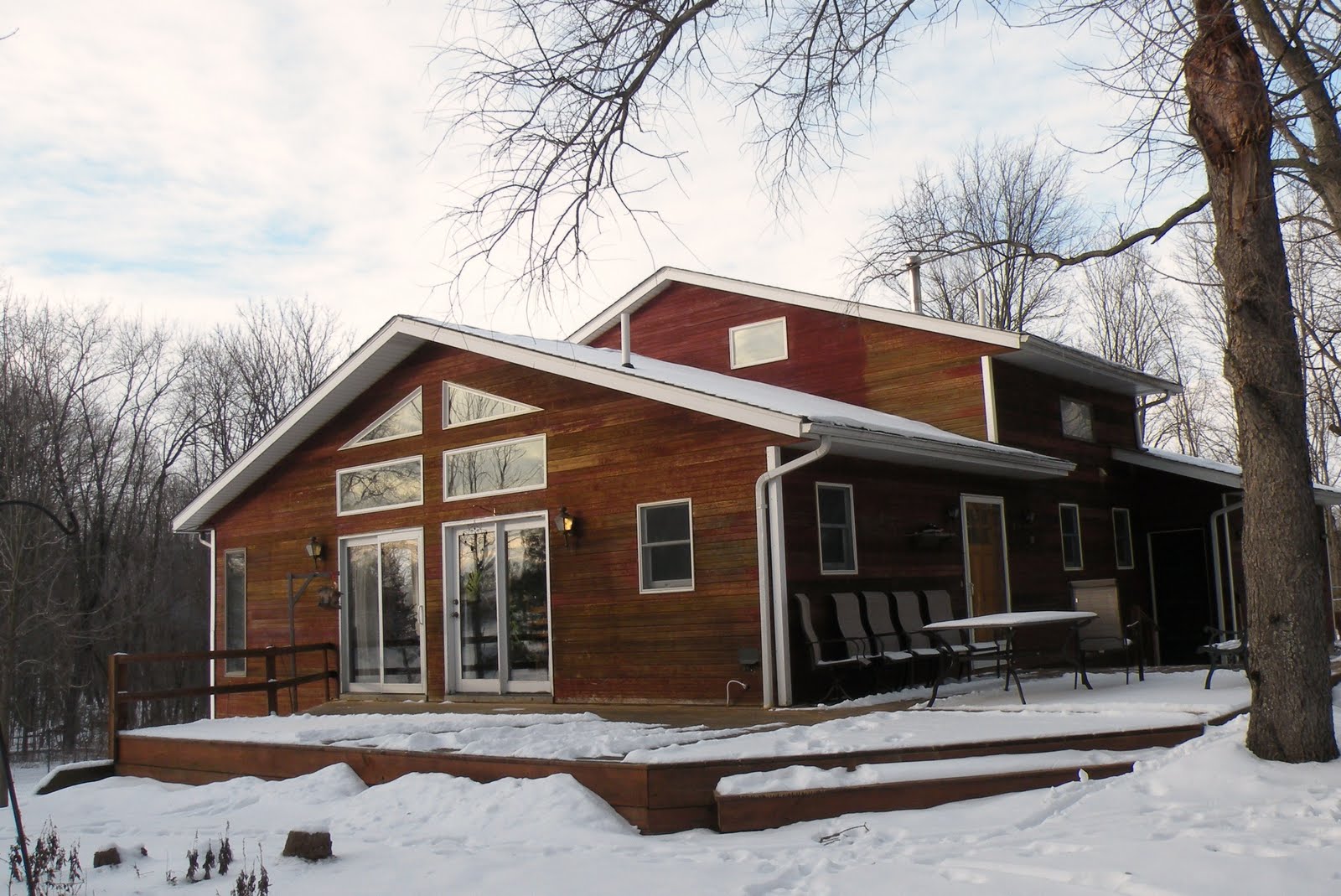


I was the Jones Barn. That means I stood in Jones, MI. Don’t know the last name of the man who raised me. But in the 1980’s a man came to take me down. Gary Nofsinger.

I stood on a neat and tidy farm, and I was well preserved. I had been painted and repaired over the years, right up until then. But finally I was deemed, well, useless. There were no animals to shelter, no hay to store.

At no cost I was given away. To make the farm look all the more orderly. Gary took a whole summer, working alone, to take me down.

While you may think this an affront, beams know when they are seen, touched, dismantled, and re-created, re-born, with what you can only call love.


“Why did you decide to build your home from these old beams, Gary? Is it less expensive than conventional building?”


“Oh, no, it’s not less expensive.
Why did I do it?
I love wood,” Gary said.


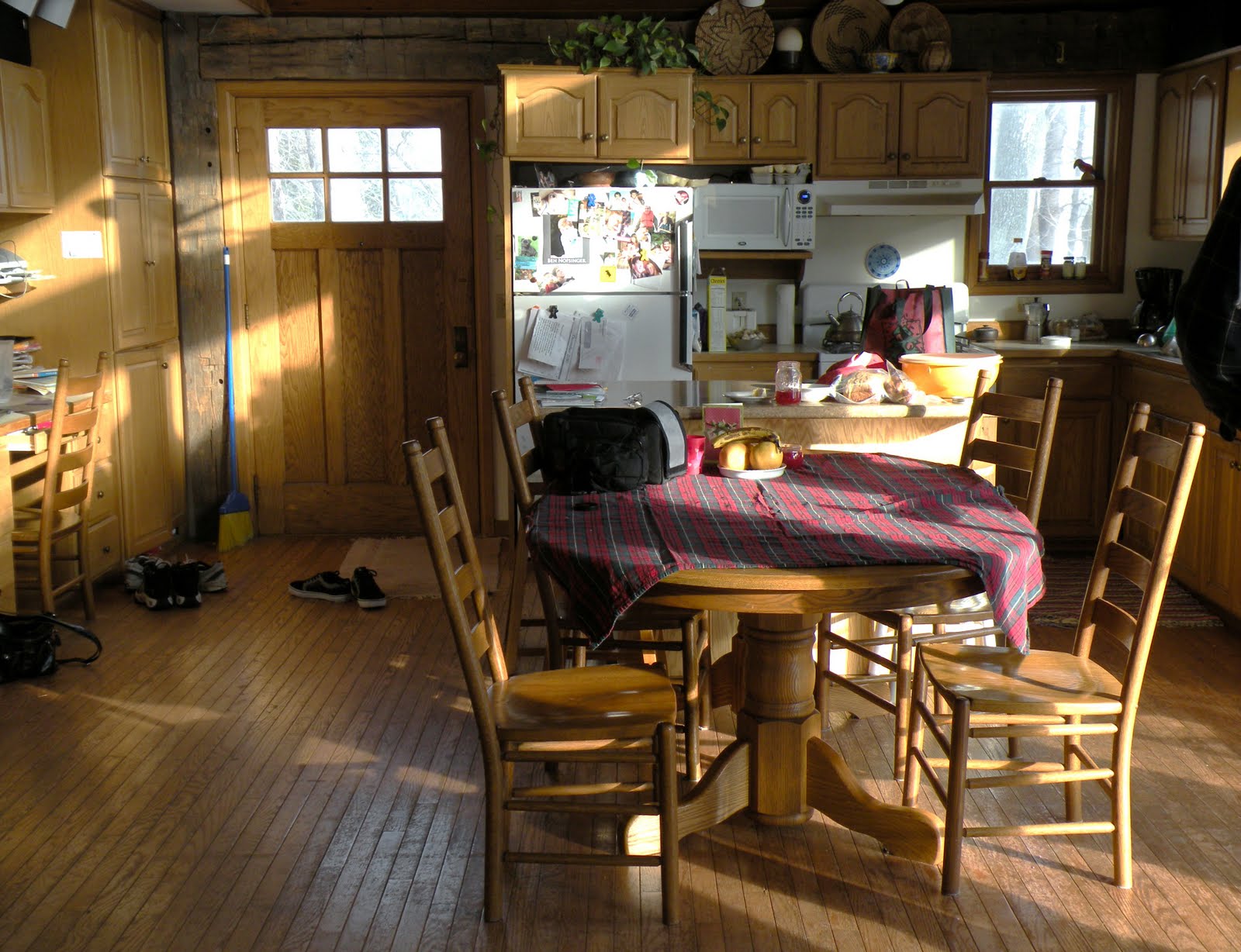
“See those ceiling boards. They were the floor of the main level of the barn. On the other side you can see the pokes of the pitch forks that were used to move the hay around. But this side, the side we see, is the same wood the cows looked up at when they were being milked.” Gary beams.


Gary chose me, the Jones Barn, for my southern pine horizontal siding. He knew what he was looking for, the texture and design of the wood that would mark his home. He could see the subtle variations in red brown colors. He could see my straight boards.


And he recognized in me a unique character. I was built as a bank barn, pretty typical of this are. The ideas was that the bank of earth that came up to my main level could be used to make easy access for hay wagons as they backed up there for unloading. But for some reason, my bank of earth was never built up. So for years my long hay hooks had been lowered to ground level in order to grasp hay, raise it up, swing it over the hay mow, and drop it down.

Gary knew all this, could see all this, after growing up doing chores in his family barn in Illinois. He and his dad and brothers spent hours in the same process, hitching up long ropes to raise the hay hooks, lifting, rolling the hook back over the track until, click, it stopped, the rope was pulled, they hay released, and it fell down into place, thunk.

“Just like that,” Gary said.

“How old were you when you started doing chores with your dad?”

“I don’t know. As soon as I could walk. But I loved it. None of the other kids really loved it. But driving the WD Allis Chalmers tractor, making hay, feeding the hogs and cows, being out there alone in the fields. I always loved it. Sounds silly, I guess….”

“Did you think about farming?”

“Well, you know my dad worked full time.”

“On the farm…”

“No, he had a regular job. He did farm work after work. But he made money off of it when other small farmers were struggling to survive.”

“How did he do that?”

“Well, he had the one tractor for planting, WD Allis Chalmers, all the years. Just four plnaters, that's all. Oh, and it broke down. But he didn’t go with the trends for bigger equipment and more and more chemicals. He figured he was running the farm just fine and did not need all the rest. And he made good money off his soybeans and corn.”

“So, to follow his pattern, you would have to keep doing Woodshaper work and run a productive farm in your spare time.”

“You got it. Besides making some hay and gardening, a few goats and chickens, that’s enough for right here.”



“And what about the family farm in Illinois, now...since your dad died.”

“It’s rented. Still stays in soybeans and corn, like my dad grew. We keep talking about when my mom will want to sell. They always saw this as their ‘retirement fund.’ They were right. Land serves as a great investment. It is worth, I guess, $7,500 an acre about now. But it has not been time to sell yet.”

“And the barn is gone.”


“Dad took it down. And when I saw the siding I asked for it. That’s what sides my shop. Not southern pine, like the Jones barn, but some other pine. I don’t know what kind. I just know, from the way the home barn was built with hewn beams and some of the rafters half rounded, that it dated from the 1880’s. That makes that siding, that wood, at least 130 years old – from when it was cut down for the barn.”


“So you work in there, surrounded by the boards and the memories of that home farm, home barn. I never knew….”

“Yeh…

“But if you want to know what I really love, look up there. See those ceiling boards? That’s what really excites me. Those are the same boards the cows looked at when they were being milked in the barn at Jones. Isn’t that something?”


Gary loves wood.


Monday, December 13, 2010

Lind Home: Recycled Barn


I talked with Tim Lind and his daughter, Rose, under the tall ceiling at the center of their home made from old barn beams on Tuesday, December 7, 2010. Though I had been in this home many times, I saw it in a sweep of seasons in the life of the trees that shaped it. The beams of this home have been recycled from an old barn in Ohio.


These beams have known three seasons.

In the spring of life, some three hundred years ago
they sprouted from maple wings, acorns, hickory nuts
walnuts, and cherry stones, in woods
walked by bare feet, moccasins, buck boots. They grew.
They forested what we now call Archibold, Ohio. Peoples
not like us later leaned on these towers of wood and searched
their leaf litter for nuts, mushrooms, the tracks of deer.
Some say these forests were so tall that Europeans
could ride through on horseback, the broad
trunks holding the tall canopies shading
out the undergrowth.


These giants become the timbers of summer, those
felled for barn beams for settlers some hundred
and fifty years gone. A man’s embrace could
just surround them before they fell. A horse
and team was needed to drag them, all thirty
and more feet in length, to be designed
into posts, beams, joints, elbows. Framed
in successive sections, laid one on the other,
the homestead community raising these beams,
made a barn in the mid-1800’s. A large barn. Strong.
For hay,straw, grain, cows, and horses. A barn that stood straight
and tall as timber.

Centuries move. Late summer, then fall. Family farms
fell; fields went fallow or for rent. Timbers,
barn timbers, stood silent. A huge
barn needing tending, painting, protection. Standing
alone in layers of additions. Beams mature and broad.

Fall in Three Rivers, Michigan: the Lind
land lay fallow. It too had seen seasons: forests
and wetland, corn field now empty, open to
dreams of Lind pines and cabins,
tee-pee dwelling, camping, and a green, green farm.

Trees, beams, posts, space,
salvage, soul. These were the calls
of fall that came. They lit imagination.
They opened books
on barns, joints and mortises. In
Pennsylvania, Tim Lind was taken, Yes.
He would build a post and beam house, no, home.
In balsa wood it began.


Friend, Sanford Wyse, in Ohio found
the Archibold barn and made the connection. So friends and their kids
gathered for one hot summer week, and down the beams came,
beams sprung from spring, beams
that had stood hot the summers of farm shelter,
the boards of oak siding –
these all came
down. And onto
a semi-
truck they moved
and entered the fall
season of Harder Road,
Michigan, the Land of Linds.

Under the cover of tarpaulin and snow, submerged
in a hole of creation with hand tools
alone, Tim labored in contemplation, chiseling
each joint, the geometry
figured through winter. (Though this was only
a pre-sage of winter, the last winter, to come. )


Before fall came once more
just a year later, these timbers,
re-fashioned in dove joints and angles
arose. Once more in successions of people
and pulleys, these trees were reborn from a barn to
a home. The photos proclaim it: a barn-
home is rising! See kids perched on new beams. New bones
of the skeleton now only await new skin,
new life, new breath, warmth and, yes, food.


Friend after friend, soulmates over seasons,
with Tim placed each floor board, cupboard, windows, the doors.
Then a family of eight each had room, all and one.
A family keeps growing while boards settle down.


While warmth glows through snowfall, it is not the beams' winter.
The life of this structure is vibrant and beaming.
Family flocks here, all for Christmas.
A new tree is felled for the Christ,
a small gift. Warmed by wood fire from trees of this land
the high ceiling beams show, new timber
is standing around yet to build on and on.

“What of the future,
the winter ahead?” It is this yet I wonder…


Tim notes successions of trees in the woodland.
White oak stands shift to soft maples. Wetlands
rise, killing the maples, the next season
to fall allowing the maples to spring up again.
The land has its way, its wisdom, its shaping.
“I am not shaping the land, but only
part of the shaping.” Beams aren’t forever.
People will be in this place at the decay
of beams that were sprouted among people long gone.

Light years it takes to beam food to each tree leaf.
Light casts on snow beams from home, never complete.

Monday, December 6, 2010

MAPLE TREE MEADOWS – TWO BARNS, ONE FARM


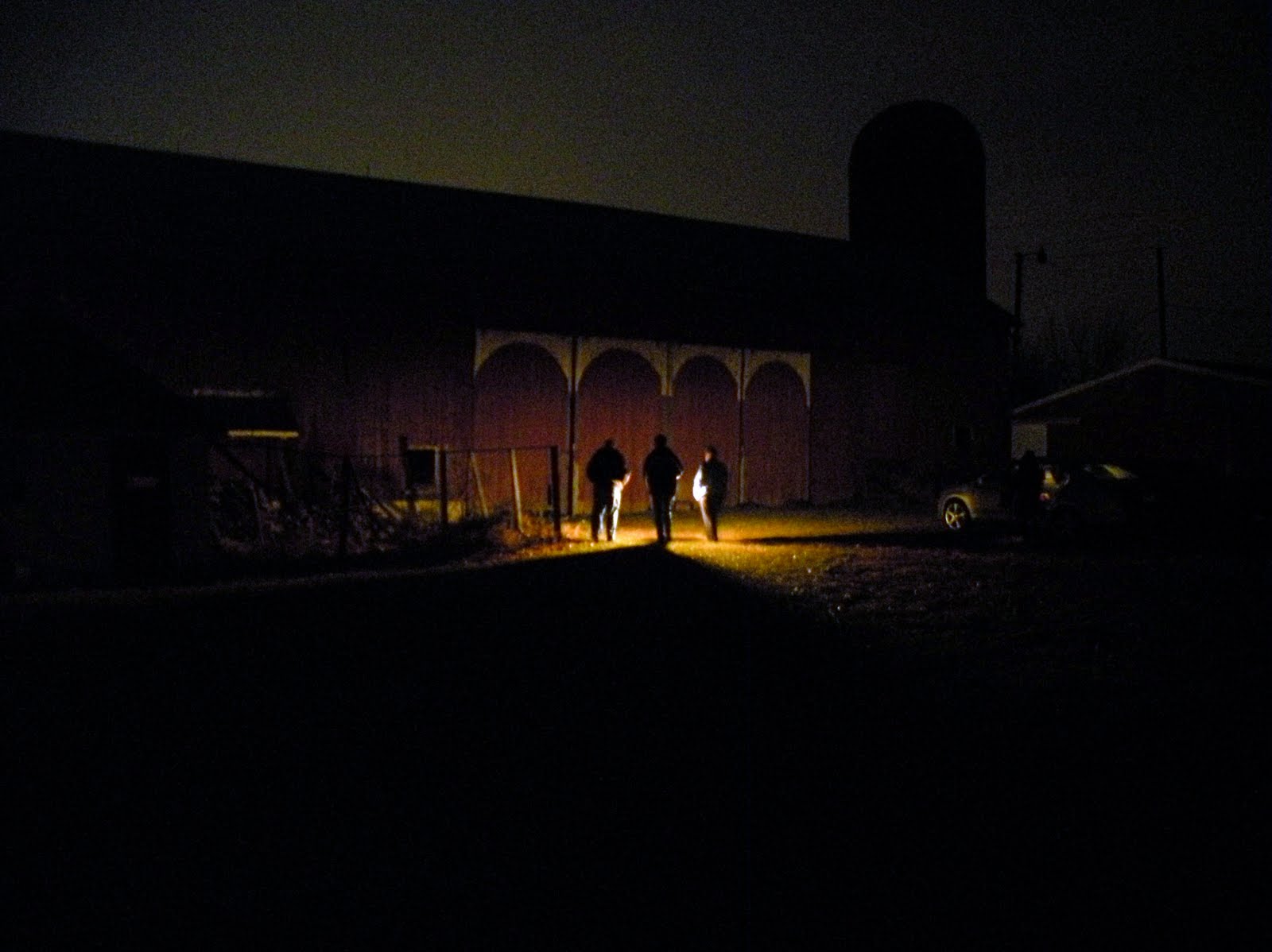
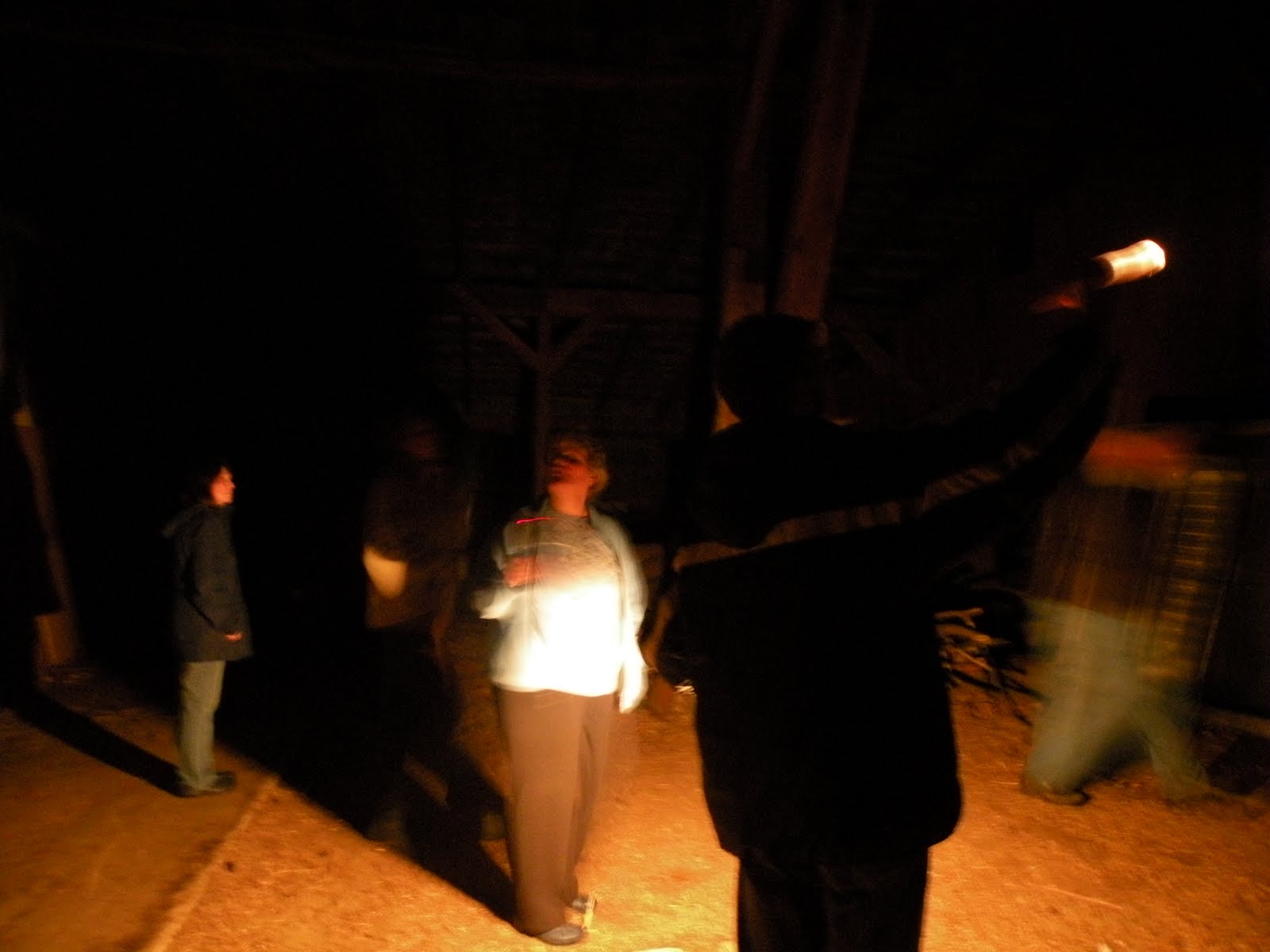
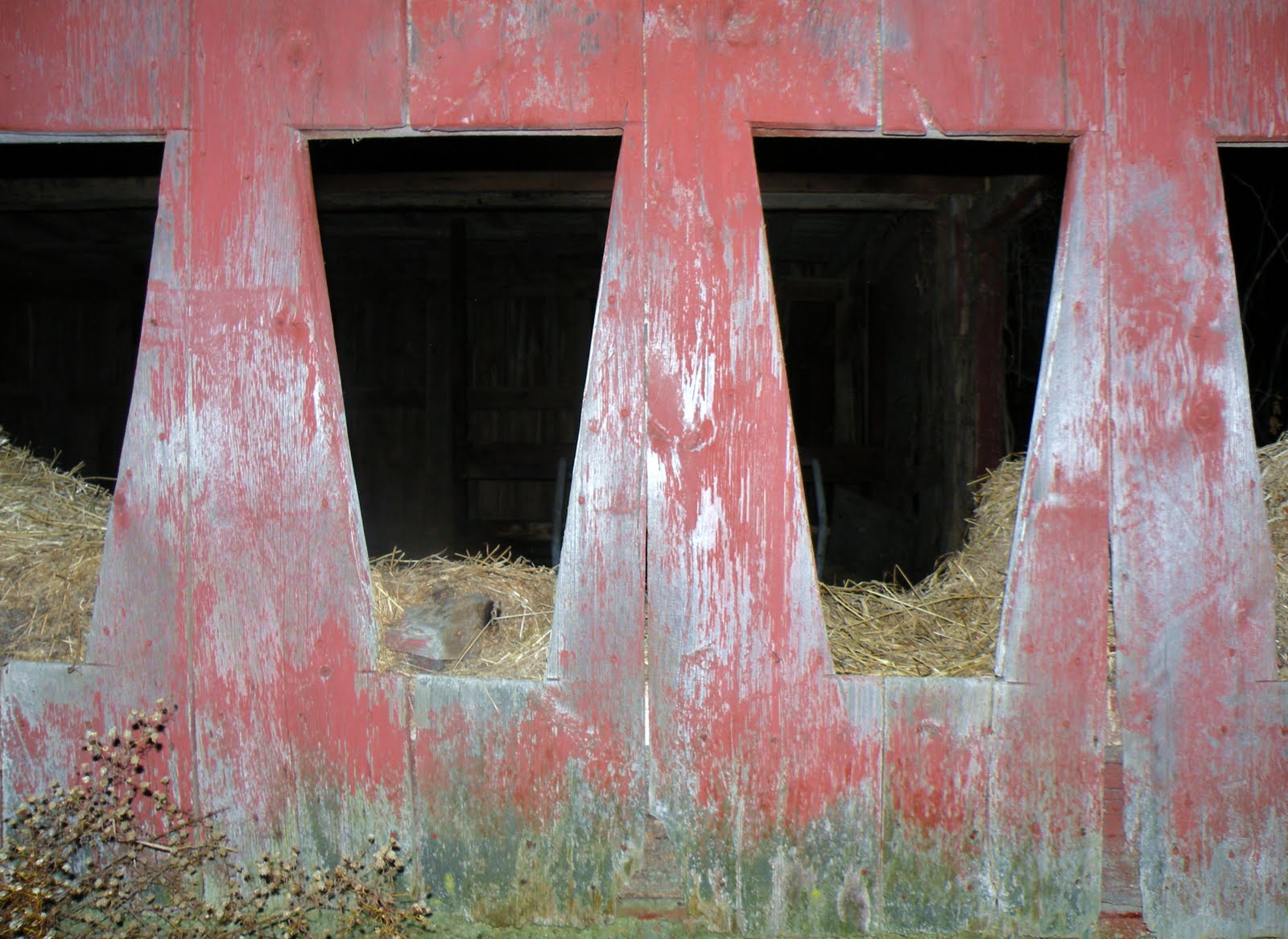
On the night of Sunday, November 21, Karla Kauffman, Willard and Kathy Fenton-Miller and Steve and Jan Stuckey gathered to eat, talk and tour barns in the dark. Listen in to this whimsical early winter tale of two barns, competing for history, competing for our attention. (Photos thanks to Kathy Fenton-Miller)


Okay, here we go with a REALLY BIG BARN STORY!
Why, everyone can see, even driving by on 131 before they get to Three Rivers,
that I AM A CENTENNIAL BARN –
Gleason Meadows, est. 1849.


Wait a minute, wait a minute. You know you lie!
Well, at least if you are claiming that 49-er fame for yourself!
I was the 1849 barn, the original barn,
the Gleason homestead barn.
Just ‘cause you can’t see me from the road
does not mean I am not famous!


Hold on here, I know, I know!
But just because people don’t speak "barn"
doesn’t mean I don’t have a story.
How do you know I am not as old as you are?
People can only wander around and poke at my beams, guessing.


You, well you’re just a transplant.
Why, no one even knows any more who built you
and where you came from…
I’ve heard some people would suggest
that they tear down YOU to restore little old me!


Tear me down?! Now who said that?
Not that new woman owner, was it?
I clearly heard her say she thought she would tear YOU down to fix me!

No wait one darn minute! This will only get us all fired up.
And you know what that can mean to us old barns…


Remember that lightning bolt…

Now hold your horses (hah! if you only could!)…
How about we band together to get this story told.
I mean, realistically, we are both in danger.


Unless someone loves us a lot, we are both goners, sooner of later.
Those folks creeping around here in the dark with their lantern and flashlights seeing what they could “reveal” deserve the down low.


Okay, I get your point, “O Wise One.”


Oooh. I like that.
Just call me Wise.
And you can be…


BIG BEN.


Yeh, BIG BEN.
Sounds kind of timely (chuckle, chuckle).
But, in all fairness, Wise, I guess you get to start.

At the beginning….
The Gleason family moved to this land from New York
in 1849 to homestead.
A lot of folks were moving in about then.
And me, my beams and boards were hewn
from the 80 acres of timber that were on this farm.
I am home grown.


Well, you know I’m from these same parts.
All the barns around here from that day were the good Michigan trees made barns.


Yes indeed, we are beam brothers.
Not too sure what the original plot of the farm was,
but five generations later Gleason Meadows had 400-600 acres.
Started with cows.
I had a generous hay loft for hay and bedding straw.
Sure lots of acres grew corn, hay, oats, to feed those cows.


That city woman walking around said you were an “Old MacDonald Farm.”
Jeez, what does she know?


Well, according to the song
I, and the other outbuildings that cropped up,
were not far from her city girl notions.
Why about the turn of the century,
sure, there were cows to milk, eggs to gather from the hens,
(the wife could always use a little egg money),
a sheep or two, definitely hogs.
Heck, farmers had to feed themselves,
and use the horses to work the land.


Yea, I guess we were a pretty normal farm.
But no E-I-E-I-O that I recall…

Let’s get the Gleason part straight.
First, in 1849, there was Alva and Laura Gleason.
Then Henry Caleb Gleason.
Third generation was Harry and Lucy Gleason.
Fourth, Henry and Aileen Gleason.
And finally there was Jim.


Interesting how some of the wives names have disappeared…


Well, you know farming has always been
a father and son thing.
And Jim, well, he had two daughters,
so in the end the farm went for auction in 2003
– in parcels, that is.
And Karla,
well, she is one of those liberated farm daughters from Ohio,
and now we belong to her.
Now we are Maple Tree Meadows.
That’s what Karla named us.
And that’s that.


That’s that? What? You left out all the juicy parts, Wise!

Well, Big Ben, you never were shy of letting it all hang out.
Go for it.


Well the whole reason I got moved here, beam by beam, number by number,
was because of the big fire.
You were lucky, Wise.
When that lighting bolt struck in 1902 all the buildings burned down
except for you.
Sometimes I do wonder if you lost half your beams when…

Now, don’t get personal on me, Ben…

Well, in 1905, after that fire,
one of those Henry’s or Harry went to find ME at a nearby farm,
and I was SO IMPORTANT that they put me back together again right here.
I had a hay trolley so that when the hay wagon pulled in my big hook
could hall up bales and fill my mow (that towers over yours, by the way).


What an ego!
Now, you know that by 1915 we were working together.
Why, the whole farm had a reputation
as a dairy forerunner with our new Holstein herd.
Other folks still had Guernsey’s,
but those black and white Holsteins had lots of milk, low fat.
Sounds pretty 21st century, if you ask me.
That Harry Gleason was some dairyman!


In 1950 I had a brand new milk house attached.
Cows milked by machine.
Milk pumped from the milk house to the milk truck.
We were pretty smooth, you and me, Wise.

Ah, those were the days at Gleason Meadows Farm…

But you know that story “of which we must not speak.” You know the PBB…

Well, that is not a secret, and it was not OUR problem.

All the dairies, all the animals in the whole area were given feed
tainted with that PBB – doesn’t even have a real human or barn name.
Got hooked up with the “C” word, and out stock was done for.
Some people say it is still stored in people’s fat cells,
percolating cancer around here.

The whole herd – 150 cows -- was sacrificed, put down
– wasn’t that about the mid- 70’s? –
to make it right.
And they paid. Oh, they paid for that PBB mess.
All new herd.


Yeh…hmmmm…

Tried raising veal.
Lot’s of problems keeping those little cows healthy.
Had a “maternity barn,”
but that didn’t work too well, either.

Went from cows to horses. Stalls made over. Still stored hay, straw.

But I think in Jim’s day,
most of the farms were struggling around here.
Seed corn was in.
Small farms….well,
not too easy to keep even
a BIG small farm like Gleason Meadows thriving.


And then there was the auction….
So, here we are in the new day of barns.
You know, I hear that some folks on the west coast are going around
finding barn beams to make their designer houses.
Imagine!


Not sure what Karla is up to.
Got to admire her guts –
buying us two old men of barns,
the old farm house, and twelve acres
while she’s in her fifties.

Maybe it takes someone whose joints are aching to love another…

Shhhh….we’ve got to keep in her good graces.


I think she’s thinking, praying about us.
She’s gone a lot.
Her dad, the dairy man who gave her this “barn love”
died last year.
His farm will go to a young Ohio farmer now.
Then she will settle back in with us.


She says she wants to “grow people” here.
Women come and study the old ways, plant gardens, pray.
Friends and neighbors store tools, tractors, boats in me.

And I sometimes look the part of a Nativity play.
You know what they say: “He was born in a barn!”


Hmmm…
Guess all we can do is join our new owner in pondering.

Listening to the pigeons and swallows…

And the cats…

And the wind…

And waiting for Maple Tree Meadows
to be “barn” again.


Oh, Wise...
Some things never change…

Sunday, November 28, 2010

St. Joseph's Barn


I visited St. Joseph's Barn at The Hermitage on Dutchsettlement Road, Three Rivers, on Thursday, November 11. David Wenger, one of the directors there along with his wife, Naomi, told me the story of St. Joseph's barn. You will see how I put that story "into the barn's mouth" below.


St. Joseph’s Barn.
My Story.

It is remembered that I was raised in 1898.
But the people who live here now don’t know who made me.

Of course, I have lived here longer than any human.
Only the trees know.
The earth.

But as it is with us barns,
I stand on evidence
of stones laid with care as foundation,
old stall space for cows,
and beams hewn thick and strong,
straight for these one hundred and more years.

Owners in the 70’s lived by me in a double wide
and thought of making me their home.
But it was Gene and Mary Herr in the 80's who had
vision
to make me
“space for God.”

Named after the county
and the carpenter father of Jesus, it took
a carpenter artist to remake me
from the inside out.


My outside gaps where the wind crept in
were sealed
and Jim Schwartz (Centreville)
re-arranged my inner space
while leaving beams and logs, ladders to the hayloft,
as structure.


First three rooms,
then a bath,
a space to gather,
and a two level apartment
hung for long term
volunteers.
Four more rooms,
a bath,
a chapel,


and centering my soul
a spiral stairway
descending
to the kitchen
dining
silence
together.


But windows will whisper:
I was shaped as much
by silence and prayer
and faith for the finances
as boards and beams.

The Hermitage,
this land and space
around within
me, the barn,
shelters pastors, leaders,
seekers, finders
in a barn made holy by silence seeking God.

My skin has been torn away,
the old boards salvaged as they came down last summer.
I don’t look the part of a centennial barn, but my insides cannot lie.

When I look ahead,
I see fewer cars coming, with the end of gas
and the earth turned back to growing.
Food, God’s love
made visible, now
fills extra space at The Hermitage
around silence.


In another hundred
years, who knows?
Many farmers, dwellers in silence, soul
and soil may share this place.

I will hold the old stories for them
if they look,
and listen.

Wednesday, November 10, 2010

STORY BARN PROJECT EXTENDS SABBATICAL FOR FLORENCE PASTOR


PRESS RELEASE
A passion for barns and their stories is one of the outcomes of a recent sabbatical for Nina B. Lanctot, pastor of Florence Church of the Brethren Mennonite (Constantine, MI). In the coming year she will interview local residents to learn the stories of their barns.

In order to understand the evolution of farming in our area, Lanctot will visit barns of all types over the coming year. Through photography, taped interviews, a blog, and gatherings of interested people, Lanctot will share the Story Barn project with the local community and churches. Pole barns, centennial barns, remade barns and abandoned barns are all of interest as part of the story of changing farm culture. A final multi-media celebration of the project will take place on Sunday, November 20, 2011.

Barns built by George Sherck are of special interest to Lanctot. Sherck, a farmer and barn builder, was also the first pastor of Florence Church, from 1929-1947. A dozen or more Sherck barns still stand in St. Joseph and Cass Counties. In 2011, as Florence celebrates the eightieth anniversary of its official founding in the Church of the Brethren, its rural heritage will be honored as part of the Story Barn project. Florence has also joined Mennonite Church USA in the last fifteen years.

A potluck kick-off for the Story Barn project will take place on Sunday evening, November 21 at 6 pm at the home of Karla Kauffman. The former Gleason Farm at 15352 Gleason Road (Three Rivers, MI) was purchased recently by Kauffman and has been renamed Maple Tree Meadows. It is located just west of the intersection of 131 and Gleason Road. The story of the main barn and a tour will be part of the evening.

As a recipient of a Lilly National Clergy Renewal Grant, Lanctot explored Vibrant Rural Churches and Communities. A pastor with an urban background, Lanctot wanted to experience rural life on small farms over a two month stay.

When Ezra Graber, long time Constantine seed corn farmer, learned that Lanctot grew up in Philadelphia, he said of her project, “You have a lot to learn!”

In Lanctot’s sabbatical away from the congregation in February and March, she lived and worked on small farms in Costa Rica. After studying Spanish as a child and through college, Lanctot’s life long dream was to gain fluency. After two months in Costa Rica on her own, Lanctot returned for two weeks in the summer with her family to find that indeed, conversational Spanish flowed with ease. Spanish language is used frequently at Florence Church and in the local community.

Costa Rica’s ecotourism fosters the shift from large, single crop farms of bananas and coffee to smaller production site. The biodiversity and beauty, ingenuity and resourcefulness of small self-sustaining communities stretched Lanctot’s imagination for farming and good food production in southwest Michigan.

Lilly Endowment awarded 133 grants in National Clergy Renewal Program in 2008. Florence Church of the Brethren Mennonite was awarded $45,000 to be used for both pastor ($30,000) and congregation ($15,000). Members of the ninth class of the National Clergy Renewal Program – 138 pastors representing 133 congregations – report about their experience by the close of 2010 having embarked on their own adventures. Funded by the Indianapolis-based Lilly Endowment Inc., the program gives pastors and congregations the opportunity to create their own sabbath journeys.

Florence Church of the Brethren Mennonite and their pastor, Nina B. Lanctot, explored the theme “Vibrant Rural Churches and Communities.” During Lanctot’s absence Florence Church enjoyed the preaching ministry of Fridbert August, a Brazilian seminary student at Associated Mennonite Biblical Seminary (Elkhart, IN).

In addition the congregation experienced a World Cup Celebration, a canoe trip on the Fawn River, a retreat weekend at Amigo Centre (Sturgis, MI). The grant enabled the congregation to share locally grown food including freezer beef from White Yarrow, One Straw and Bair Lane Farms (Marcellus, MI). A board retreat at the Hermitage (Three Rivers, MI) in January will complete the sabbatical projects.

All these renewal programs exhibit the basic thrust of the Endowment's program: a chance for congregations and ministers to engage in mutual renewal that will have an important impact on their churches, their individual members and their communities.

"The wealth of imagination unleashed by this program is truly wonderful to see," says the Endowment's Dykstra. "We can think of no better way to honor these hardworking men and women than to help them experience personal growth and renewal in ways that they themselves dream up and feel will feed them most deeply."

The Endowment plans to continue the program for Indiana Clergy in 2011.

More information about Story Barn and Vibrant Rural Sabbatical can be found at storybarn.blogspot.com and vibrantruralrr.blogspot.com or by contacting Pastor Lanctot at florence.brethren.mennonite@gmail.com

If you have a barn with a story, please contact Lanctot to schedule a visit.